Why One-Keyword-Per-Page SEO Is Failing in 2026
For years, the dominant SEO playbook was straightforward: identify a keyword, build a page targeting that keyword, acquire a few links, and wait for rankings. It worked — when search engines evaluated pages mostly in isolation. Today, that approach has a fundamental flaw.
Google's algorithms have shifted from page-level evaluation to site-level topic understanding. When a user searches "property lawyer Malaysia", Google doesn't just ask "which page is most optimised for this keyword?" — it asks "which site most comprehensively understands Malaysian property law, has covered it from every angle, and has earned recognition as an authoritative source on this topic?" The winner is not the page with the most keyword mentions. It's the site with the deepest topical coverage.
This shift has a name: topical authority. And it's become even more decisive since AI search entered the mainstream. AI SEO Malaysia strategies that don't account for topical authority are building on sand — ranking fluctuations, loss of featured snippets, and absence from AI Overviews are the predictable results.
What Is Topical Authority? (And What It Isn't)
Topical authority is a website's demonstrated depth and breadth of coverage on a specific subject area. A site achieves high topical authority on "SME financing in Malaysia" not by having one well-optimised page on the topic, but by comprehensively covering every subtopic a reader might need: types of SME loans, CTOS vs. CCRIS explained, government grant programmes (TEKUN, SME Corp, MDV), application processes, rejection reasons, working capital vs. term loans, and Islamic financing alternatives.
When a site covers the full question space of a topic — leaving no important subtopic unaddressed — Google's algorithms begin to treat it as the go-to reference for that subject. This is fundamentally different from domain authority (DA), which measures link quantity and quality. A specialist site with domain authority 30 but deep topical coverage can and routinely does outrank a DA 70 generalist site for specific topic queries.
Why AI Search Rewards Topical Authority More Than Traditional Ranking Signals
Google AI Overviews don't just pull from the page that ranks number one. They synthesise information from multiple sources they've identified as authoritative on a topic — often drawing from pages that rank third, fifth, or even beyond page one, if those pages contain highly relevant, credible information that fills a gap in the AI's synthesis.
This fundamentally changes the competitive landscape. AI search rewards breadth as much as depth. A site that has thoroughly answered 40 questions within a topic space will be cited more frequently than a site with one exceptional page and nothing else surrounding it. The AI needs enough content to synthesise from — sites with comprehensive topic coverage give it exactly that.
The same principle applies to Generative Engine Optimisation for platforms like ChatGPT and Perplexity. These AI systems learn from patterns of comprehensive, accurate coverage — websites that appear repeatedly as credible sources across a topic get reinforced as authoritative references in their training data and retrieval systems.
The Content Cluster Model: How Topical Authority Is Built
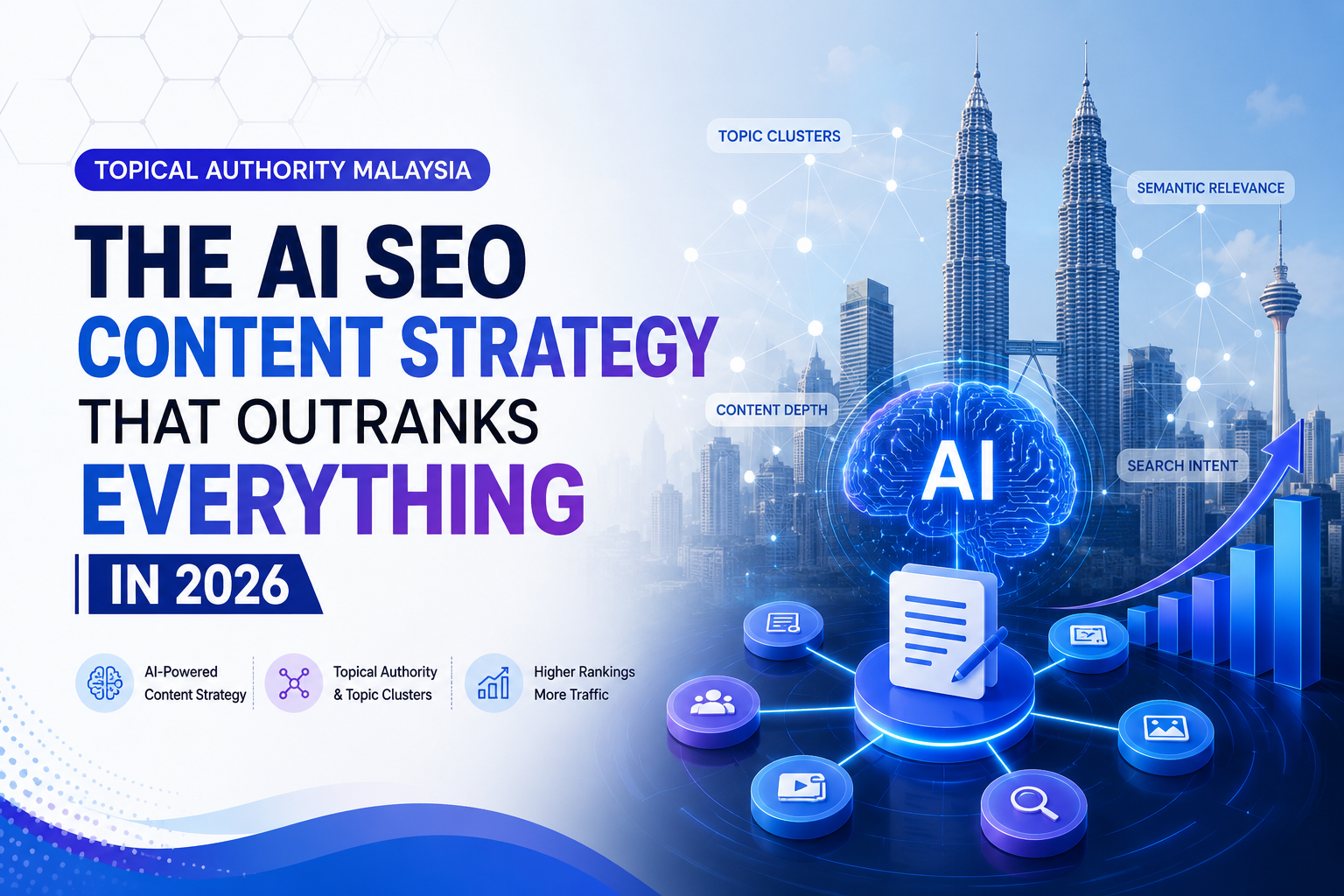
The most practical framework for building topical authority is the content cluster model — a hub-and-spoke structure where a comprehensive pillar page is surrounded by a series of in-depth cluster articles covering every significant subtopic.
The Pillar Page: A 2,000–4,000 word comprehensive overview of the core topic. It covers the topic broadly, addresses the most common questions, and links to each cluster article for deeper reading. The pillar page typically targets the broadest, highest-volume keyword (e.g., "SME loan Malaysia" or "digital marketing Malaysia").
Cluster Articles: Each cluster article covers one specific subtopic in depth (1,000–2,000 words). They target more specific, lower-volume keywords with clearer search intent (e.g., "TEKUN loan application guide", "difference between working capital loan and term loan Malaysia"). Every cluster article links back to the pillar page, and the pillar page links to each cluster article.
The Internal Link Web: Cluster articles also link to each other where topically relevant. This creates a dense internal link network that signals to Google the semantic relationships between topics — and tells the algorithm that your site has covered the subject exhaustively.
A 6-Step Topical Authority Strategy for Malaysian Businesses
Step 1: Define Your Core Topic Space
Your core topic is broader than your target keyword. A property developer in Johor doesn't just own the keyword "new launches JB" — they should aim to own the topic space of "buying property in Johor Bahru". Every question a prospective buyer might ask within that journey is a content opportunity. Start by brainstorming 30–50 questions across awareness, consideration, and decision stages.
Step 2: Map the Full Question Space
Use Google's "People Also Ask" boxes, Ahrefs' Questions filter, or Answer the Public to systematically identify every question being asked within your topic. Group these questions into subtopics — each group becomes a potential cluster article. For a Malaysian HR consultancy, subtopics under "employment law Malaysia" might include termination procedures, EA coverage thresholds, EPF contribution calculations, SOCSO claims, and foreign worker levy management.
Step 3: Audit Your Existing Content Against the Question Space
Map your existing content to the question space. Which questions are already answered, adequately or inadequately? Which are entirely missing? This gap analysis is your content calendar. Prioritise gaps where search volume is highest and where competitors have thin coverage — these are the fastest wins for both organic rankings and Answer Engine Optimisation snippet ownership.
Step 4: Build the Pillar Page First
The pillar page is the anchor of your cluster. It needs to be the single best introductory resource on your topic — comprehensive enough to cover every major subtopic with a clear overview, specific enough to be genuinely useful, and structured with internal links to point readers toward cluster articles for deeper reading. Invest in this page's quality; it will be the page Google evaluates first when deciding whether your site merits topical authority status.
Step 5: Produce Cluster Articles Systematically
Work through your content gap list methodically — one cluster article per week is a sustainable pace for most Malaysian businesses. Each article should fully answer one specific question or subtopic, include structured FAQ sections targeting People Also Ask opportunities, and link contextually back to the pillar page and at least two other relevant cluster articles. Quality matters more than volume: ten excellent cluster articles will build more authority than thirty thin ones.
Step 6: Build Internal Links Contextually and Consistently
As each new cluster article is published, update previously published articles to include contextual links to the new content where relevant. Use descriptive anchor text that reflects the topic of the linked page (e.g., "TEKUN loan application requirements" rather than "click here"). Over time, this creates the dense semantic network that signals to Google — and to AI synthesis systems — that your site covers this topic from every angle.
Topical Authority vs. Backlinks: The 2026 Reality
Backlinks remain important — they're the off-page credibility signal that complements topical authority. But the relationship has shifted. In 2026, topical authority is increasingly the prerequisite that makes link acquisition effective. A single high-quality editorial link to a site that already demonstrates topical authority produces far more ranking impact than the same link to a site with thin, disconnected content.
More practically: topical authority is within your direct control. You cannot force journalists to link to you, but you can decide to comprehensively cover your topic. For most Malaysian SMEs with limited SEO budgets, topical authority building through content clusters delivers better and faster results than link-acquisition campaigns aimed at a sparse, low-authority site.
The combination of topical authority and quality backlinks is what drives professional SEO results in Malaysia at the highest level — but if you can only do one first, invest in your content architecture.
Measuring Your Topical Authority Growth
Topical authority doesn't have a single metric, but these signals indicate it's building:
- Keyword cluster rankings: Are you ranking for an increasing number of keywords within your topic space, not just your primary targets? A rising tide of cluster keyword rankings is the clearest topical authority signal.
- People Also Ask ownership: Track how many PAA questions within your topic space you now own. Growing PAA ownership means Google trusts your content to answer adjacent questions — a direct topical authority signal.
- AI Overview citations: Use Google Search Console's AI Overview report and manual searches on commercial queries in your topic space. Are you being cited? Which pages? Which questions trigger your citations?
- Branded navigational searches: When people in your topic space search "[topic] [your brand name]", it signals that your brand has become associated with the topic in searchers' minds.
- Organic traffic distribution: Healthy topical authority produces traffic across many pages, not just one or two. If 80% of organic traffic hits one page, your cluster strategy needs expansion.
Topical Authority Is an Investment, Not a Campaign
Building topical authority takes longer than running an ad campaign and produces results more slowly than many businesses expect in the first three months. But the compound effect is unlike any other digital marketing investment. Once a site establishes genuine topical authority, new content within that topic ranks faster, AI citations increase, and competitors find it progressively harder to displace you — because the gap between your topic coverage and theirs grows wider with every article you publish.
This is why the Malaysian businesses that started building topical authority in 2024 and 2025 are the ones earning AI Overview citations with comparative ease in 2026 — while those still optimising page by page are watching their organic traffic decline despite holding page-one rankings that now sit below an AI Overview that doesn't mention them.
Topical authority, combined with E-E-A-T trust signals and the technical discipline of understanding how SEO, GEO, and AEO work together, is the complete content strategy for AI search in 2026. There is no shorter path to sustainable AI search visibility.
Ready to map your topical authority gaps and build a content cluster that earns AI citations? Request a free strategy consultation — our team will analyse your current content architecture and design a cluster plan tailored to your industry and target audience in Malaysia.
Frequently Asked Questions
What is topical authority in SEO?
Topical authority is a website's demonstrated depth and breadth of coverage on a specific subject area. Rather than evaluating individual pages in isolation, Google assesses whether a site collectively covers a topic comprehensively — answering the full range of questions a user might have. Sites with high topical authority rank more easily for new related keywords, attract AI citations, and earn featured snippets at a higher rate than generalist competitors.
How is topical authority different from domain authority?
Domain authority (DA) is a metric reflecting the quantity and quality of backlinks pointing to a site — it's link-based. Topical authority is content-based: it measures how comprehensively and accurately a site covers a given subject. A specialist site with moderate DA but deep topical coverage consistently outranks high-DA generalist sites for topic-specific queries — especially in AI search, which prioritises contextual relevance over raw link scores.
How long does it take to build topical authority?
Initial topical signals can appear within 2–3 months as Google indexes and interprets a well-structured content cluster. Meaningful ranking improvements for competitive keywords typically take 4–8 months. Full topical authority — where your site is consistently cited in AI Overviews and dominates a keyword ecosystem — builds over 12–24 months of consistent, high-quality content production.
How many cluster articles do I need?
There is no fixed number — coverage completeness matters more than article count. A good benchmark is to map 20–40 distinct questions within your topic space, then produce content that answers each. For a highly competitive niche in Malaysia (legal services, property, financial advisory), 30–50 well-executed cluster articles may be needed to reach genuine topical authority. For a more niche B2B service, 15–20 deep articles may be sufficient to dominate.