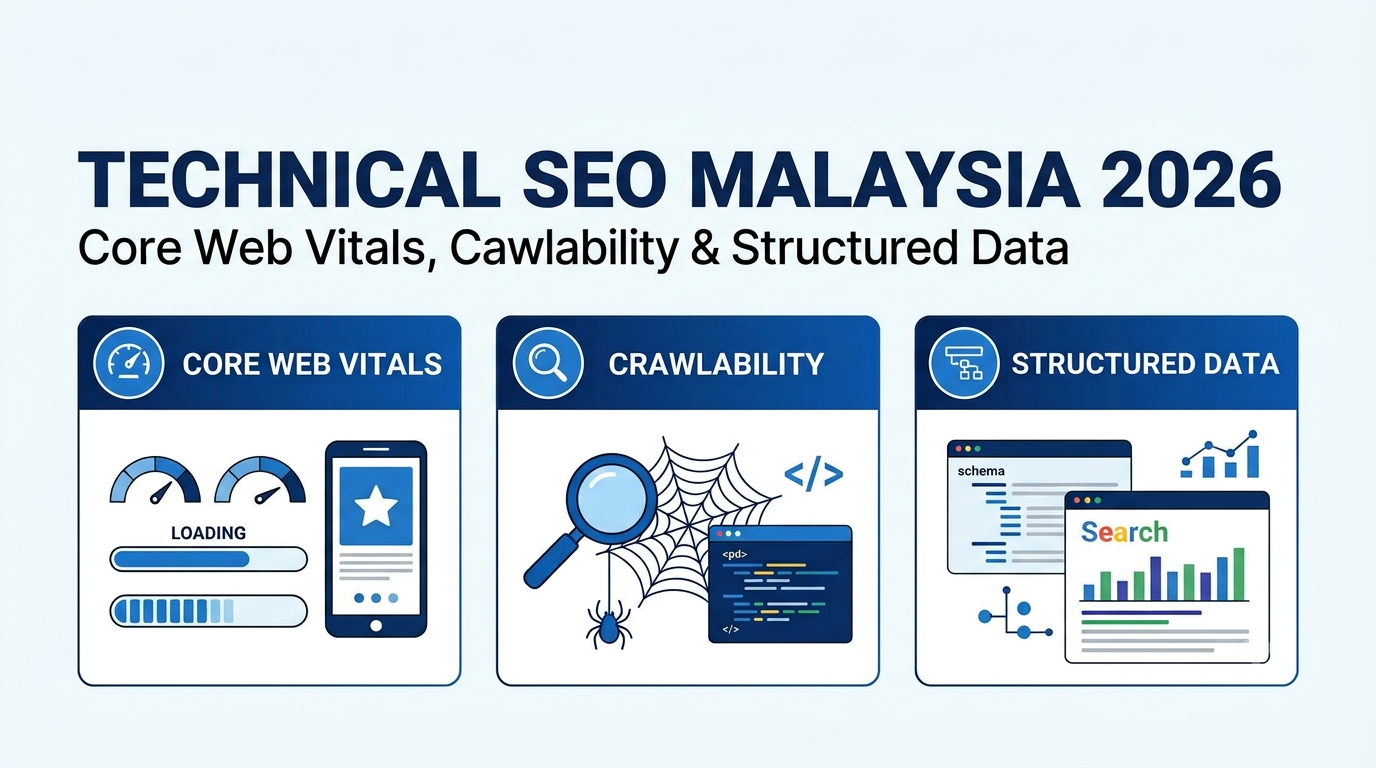
What Technical SEO Actually Covers
SEO is often taught as a content discipline — write good articles, target the right keywords, build backlinks. That's accurate but incomplete. Underneath every piece of content is an infrastructure layer that either helps or hinders Google's ability to find, process, and rank that content. Technical SEO is that layer.
In practice, it covers four interconnected areas:
- Crawlability — can Googlebot discover and access your pages?
- Indexability — is Google allowed to index and serve those pages?
- Performance — do your pages load fast enough to meet user and algorithm expectations?
- Understandability — has the content been marked up so Google's systems can interpret what it means, not just what it says?
Each of these areas has specific failure modes that are common among Malaysian business websites — and most of them go undetected until an SEO audit specifically looks for them.
Core Web Vitals: The Speed Metrics That Directly Affect Your Rankings
Google uses three Core Web Vitals as direct ranking signals. They're not suggestions — pages that consistently fail these thresholds receive a measurable ranking disadvantage, particularly in competitive niches.
LCP — Largest Contentful Paint (Target: under 2.5 seconds)
LCP measures how long it takes for the largest visible element on screen — usually a hero image, a large heading, or a banner — to fully render. Think about what this means for a Malaysian user on a 4G connection opening your services page: if the hero image takes 4 seconds to appear, they've likely tapped back before your content has had a chance to make any impression.
The most common LCP killers in Malaysian websites are uncompressed images (JPG files served at 2–4MB when they should be under 200KB), render-blocking JavaScript loaded in the document head, and slow server response times from hosting providers with data centres located outside Southeast Asia. Switching images to WebP format, enabling lazy loading for below-fold images, and using a CDN with Singapore or Kuala Lumpur edge nodes can cut LCP in half.
INP — Interaction to Next Paint (Target: under 200ms)
INP replaced First Input Delay (FID) as a Core Web Vital in March 2024. Where FID only measured the delay on the very first user interaction, INP measures the responsiveness of every interaction throughout the entire page session — every button tap, menu open, form field focus, and filter selection.
INP is the most commonly failed Core Web Vital in 2026, and it almost always comes down to JavaScript. Heavy third-party scripts — chat widgets, analytics platforms, remarketing pixels, and cookie consent managers — compete for the browser's main thread. When a user taps a button during this competition, the response is delayed. Auditing and deferring non-critical scripts, or moving them to web workers, is the primary fix. If your website uses a popular CMS with many plugins (a very common configuration for Malaysian SME sites built on WordPress), plugin bloat is often the root cause.
CLS — Cumulative Layout Shift (Target: under 0.1)
CLS measures how much the page layout jumps around while loading. You've experienced this: you're about to tap a link and suddenly an ad loads above it, shifting the page down, and you accidentally tap the wrong thing. Google penalises this because it's a genuine usability failure.
The fix is almost always structural: set explicit width and height attributes on all images and video embeds, reserve space for ads before they load, and avoid inserting dynamic content above existing content after the page has started rendering. Malaysian e-commerce sites and news portals tend to have higher CLS scores because of late-loading banner ads and product recommendation widgets.
Mobile-First Indexing: What It Means for Malaysian Websites
Google switched entirely to mobile-first indexing in 2023. This means Google uses the mobile version of your website — not the desktop version — as the primary basis for crawling, indexing, and ranking decisions. For most Malaysian businesses, this is either excellent news (because your site is mobile-optimised) or a quiet crisis you haven't yet discovered.
Malaysia has approximately 35.4 million internet users and an internet penetration rate of 98% — one of the highest in Southeast Asia. The majority of those users access websites on smartphones. If your mobile site hides navigation items, serves smaller images, or omits content that exists on the desktop version, Google's index contains an incomplete picture of your site. The ranking impact can be severe without an obvious cause.
Check your mobile experience at Google Search Console under "Mobile Usability". Common issues include tap targets too small for fingers (buttons and links placed too close together), text that requires horizontal scrolling, and content blocked by interstitials or pop-ups that Google penalises specifically on mobile.
Crawlability: Making Sure Googlebot Can Find Everything
Googlebot follows links, reads sitemaps, and interprets your robots.txt file to understand what it's allowed to crawl. Each of these mechanisms is a potential source of problems.
robots.txt Mistakes
A single line in robots.txt can block Googlebot from entire sections of your site. The most damaging version of this mistake is accidentally blocking the CSS and JavaScript files that render your pages — Googlebot then sees an unstyled, bare-HTML version of your site that looks nothing like the real experience and ranks accordingly. Open your robots.txt at yourdomain.com/robots.txt and verify that nothing critical is being blocked. If you've recently migrated platforms or redesigned your site, this file deserves particular scrutiny.
noindex Tags in the Wrong Places
The meta tag <meta name="robots" content="noindex"> tells Google not to index a page. This is appropriate for thank-you pages, login screens, and duplicate content — but catastrophic if it ends up on your services pages or blog posts through a misconfigured CMS setting, a staging environment pushed to production, or a developer test that was never removed. Google Search Console's Coverage report will show pages marked as "Excluded: noindex" — any important page appearing there needs urgent attention.
XML Sitemap Health
Your XML sitemap tells Google which pages you consider important and want indexed. A poorly maintained sitemap — one that includes redirected URLs, 404 pages, or noindexed pages — wastes crawl budget and can slow down Google's discovery of new content. Keep your sitemap clean: only include canonical, indexable, 200-status URLs. For most Malaysian SME websites, a sitemap of 20–200 URLs is normal; if yours contains thousands of entries due to filtered category pages or session-based parameters, it needs pruning.
Internal Linking and Crawl Depth
Pages buried more than four clicks from the homepage are crawled infrequently and tend to accumulate less PageRank. If your blog posts or service pages require a visitor — or Googlebot — to click through five or six levels of navigation to reach them, they're effectively invisible to the algorithm. Shallow site architecture, supported by a logical internal linking strategy, keeps all important pages within easy reach. This is why strong internal linking within blog posts matters beyond just user navigation.
HTTPS and Security Signals
HTTPS has been a Google ranking signal since 2014 and is now a baseline expectation rather than a differentiator. Any Malaysian website still serving pages over HTTP — or mixing HTTP resources on HTTPS pages (known as "mixed content") — is sending a trust signal failure to both Google and visitors. Browser warnings on your site (the "Not Secure" indicator in Chrome) actively suppress click-through rates from search results.
Beyond the certificate itself, ensure your SSL certificate hasn't expired (a common oversight for businesses that set up HTTPS years ago and haven't maintained it) and that there are no redirect chains: HTTP → HTTPS should be a single, clean 301 redirect, not a chain of two or three hops that wastes redirect equity.
Structured Data: The Bridge Between Your Content and AI Systems
Structured data — also called schema markup — is code you add to your pages that gives Google's systems a machine-readable explanation of your content. In 2026, its importance has expanded beyond rich snippets in traditional search results to directly influence Google AI Overviews and other AI-powered answer systems.
When Google's AI generates an answer, it draws on sources it can reliably interpret. Structured data makes interpretation significantly easier. A page with FAQPage schema literally provides questions and answers in a format an AI system can extract verbatim. A page with Article schema tells Google the author, publication date, topic, and publisher. A page with LocalBusiness schema confirms your location, services, and contact details.
For Malaysian businesses, the highest-priority schema types to implement are:
- Organization — on your homepage: business name, URL, address, contact, social profiles
- LocalBusiness — if you serve a geographic area: add opening hours, service area, geo-coordinates
- Article or BlogPosting — on every article: headline, author, date published, image
- FAQPage — on any page with Q&A content: structured questions and answers for AI extraction
- BreadcrumbList — on every page: helps Google understand site hierarchy and display breadcrumbs in results
- Service — on service pages: service name, provider, area served, description
Use Google's Rich Results Test to validate your schema after implementation. Errors in structured data — unclosed tags, missing required fields, incorrect data types — can prevent rich results from appearing even when the markup looks correct visually.
Site Architecture and URL Structure
Clean, logical URL structures help both users and Googlebot understand where they are within your site. Compare these two URLs:
yoursite.com/services/digital-marketing/seo-malaysia/— clear hierarchy, keyword-rich, human-readableyoursite.com/?p=142&cat=7&session=abc123— dynamic, no keyword signals, wastes crawl budget
Canonical tags resolve the most common URL duplication problems. If your site generates multiple URLs for the same content — through pagination, filter parameters, session IDs, or print versions — canonicals tell Google which version to index. Without them, you're effectively competing against yourself.
Redirect chains are another common issue in Malaysian websites that have been live for several years and gone through multiple redesigns. A chain of 301 → 302 → 301 dilutes PageRank at each hop. The rule is simple: any redirect should go directly from old URL to final destination in a single hop.
10-Point Technical SEO Audit Checklist for Malaysian Businesses
Run through this checklist annually at minimum — or immediately if your rankings have unexpectedly dropped:
- Google Search Console Coverage report — are any important pages excluded, crawled but not indexed, or returning errors?
- Core Web Vitals report in GSC — how many URLs are in the "Poor" or "Needs Improvement" bands for LCP, INP, and CLS?
- robots.txt audit — are CSS, JavaScript, or important page directories accidentally blocked?
- Sitemap health — does your XML sitemap contain only canonical, live, indexable URLs?
- HTTPS status — is the entire site on HTTPS with no mixed content warnings and no redirect chains?
- Mobile usability — does the GSC Mobile Usability report show zero errors?
- Page speed on real mobile — test your homepage and top landing pages on Google PageSpeed Insights using the Mobile tab
- Structured data validation — does the Rich Results Test show valid schema on your key pages with no errors?
- Crawl depth audit — are all important pages reachable within 3–4 clicks from the homepage?
- Redirect audit — are there redirect chains, broken redirects, or 404 pages that should have been redirected?
This checklist won't catch every possible technical issue, but it covers the problems responsible for the majority of ranking suppressions we identify when auditing Malaysian business websites. If all ten points pass cleanly, your technical foundation is solid enough that content quality and E-E-A-T signals become the limiting factors — which is exactly where you want to be competing.
Technical SEO and AI Overviews: The Connection Most Businesses Miss
There's a widely held belief that AI SEO is purely a content challenge — write authoritatively, use structured answers, build topical depth. All of that is true, but it operates on an assumption that your pages are technically accessible in the first place.
Google's AI Overview system draws from the same index as traditional search results. Pages that are blocked from crawling, slow to load, or not indexed simply do not exist as potential sources for AI-generated answers. We regularly see businesses investing heavily in AI-focused content strategies while their sites have fundamental technical problems — noindexed pages, blocked JavaScript rendering, missing schema — that prevent any of that content from entering the AI's knowledge pool.
The technical and content layers are not alternatives. They are sequential: get the technical foundation right first, then build content authority on top of it. A technically flawless site with mediocre content will outperform a content-rich site with serious technical problems in almost every case.
Ready to find out exactly what technical issues are holding your site back? Request a free technical SEO audit and our team will produce a prioritised fix list specific to your site — no generic checklists, just what actually needs attention.
Frequently Asked Questions
Technical SEO refers to the behind-the-scenes optimisations that help search engines crawl, index, and understand your website correctly. It covers site speed, mobile usability, crawlability, HTTPS security, structured data, XML sitemaps, and URL structure. Without a solid technical foundation, even excellent content can fail to rank — because Google cannot efficiently discover or process what your site contains.
Core Web Vitals are three user experience metrics Google uses as direct ranking signals: Largest Contentful Paint (LCP), Interaction to Next Paint (INP), and Cumulative Layout Shift (CLS). They matter especially in Malaysia because most searches happen on mobile devices over 4G connections — conditions that expose slow-loading, heavy websites far more than desktop testing reveals. Sites that pass Core Web Vitals thresholds consistently rank higher and have lower bounce rates.
Start with Google Search Console (free) — it reports crawl errors, indexing issues, Core Web Vitals performance, and mobile usability problems. Google PageSpeed Insights gives per-page speed diagnostics. Screaming Frog SEO Spider (free up to 500 URLs) crawls your entire site to surface broken links, duplicate titles, missing meta tags, and redirect chains. For structured data, use Google's Rich Results Test. Running all four tools together gives you a comprehensive view of your technical SEO health.
Yes, significantly. Google AI Overviews prioritise sources that are crawlable, indexable, fast-loading, and correctly marked up with structured data. If Googlebot cannot reliably access and process your pages — due to crawl blocks, slow load times, or JavaScript rendering issues — your content is less likely to be synthesised into AI-generated answers. FAQPage and Article schema give AI systems additional structured signals that improve citation probability.
Some fixes show results within days. Resolving a noindex tag accidentally applied to a key page can recover rankings within 48–72 hours of Googlebot recrawling. Core Web Vitals improvements typically appear in Google Search Console data within 28 days (the rolling window Google uses). Structural changes like site architecture improvements or fixing redirect chains may take 4–8 weeks to flow through as Google re-evaluates page authority and crawl priority.