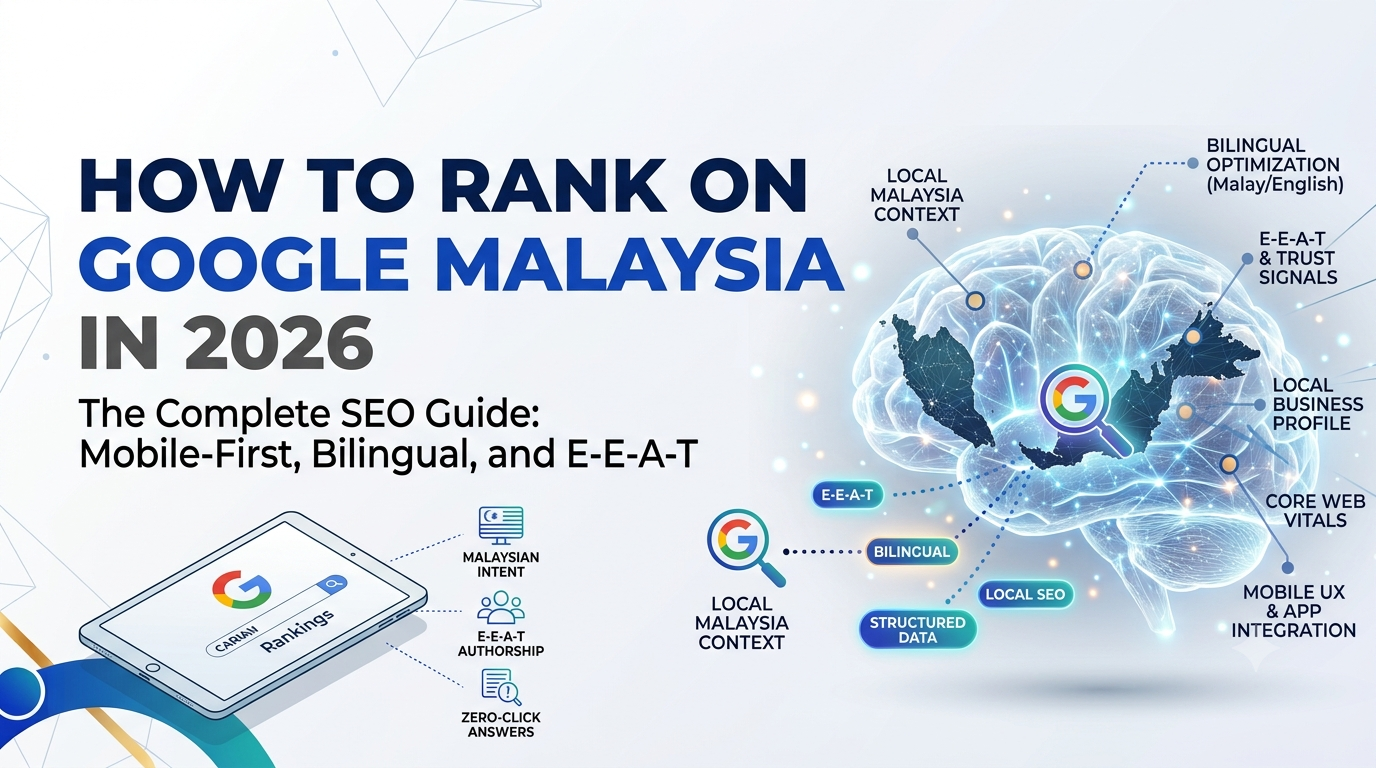
Why SEO Still Matters in Malaysia — But Has Changed
Every year, marketing commentators declare "SEO is dead." Every year, they're wrong — but they're pointing at something real. The way SEO works has genuinely changed, particularly in 2025 and 2026 with Google's aggressive rollout of AI Overviews powered by Gemini.
Here's what hasn't changed: Google processes over 8.5 billion searches daily. In Malaysia, Google controls approximately 97% of the search market (StatCounter, 2025). The vast majority of B2B and B2C purchase journeys still begin with a search query. SEO — the discipline of ensuring your business appears prominently in those results — remains one of the highest-ROI marketing investments a Malaysian business can make.
What has changed is the search results page itself. Google increasingly answers questions directly with AI-generated summaries at the very top, pushing organic blue-link results further down. For Malaysian businesses, this means modern SEO must encompass both traditional rankings and optimisation for AI-generated answers — what's now called AI SEO.
The Malaysian Search Landscape in 2026
Malaysia presents unique SEO characteristics that most global guides overlook:
- Bilingual internet: Malaysian users search in English, Bahasa Malaysia, Mandarin, and Tamil. High-commercial-value B2B searches skew heavily English, while consumer and lifestyle searches are increasingly in Bahasa Malaysia. A well-rounded SEO strategy accounts for both.
- Mobile-first reality: Over 80% of Malaysian web traffic comes from mobile devices (Statista, 2025). Google uses mobile-first indexing, meaning it ranks your site based on how the mobile version performs. A slow, cramped mobile experience directly suppresses your rankings.
- Local search dominates for services: Queries like "lawyer Kuala Lumpur", "plumber Shah Alam", and "SEO agency Penang" are how Malaysians discover local service providers. Local SEO — especially Google Business Profile — is essential for any business with a defined service area.
- Low SEO competition among SMEs: Most Malaysian SMEs have minimal or no active SEO investment. This is a genuine opportunity — it's significantly easier to rank for competitive terms in Malaysia than in the UK or Australia where SEO maturity is far higher. Early movers build durable advantages.
The 3 Pillars of SEO That Work in Malaysia
Effective SEO in Malaysia — as anywhere — rests on three foundations. Neglecting any one of them limits your results, regardless of how well you execute the others.
1. Technical SEO: Your Foundation
Technical SEO ensures Google can find, crawl, and understand your website. Without it, even exceptional content won't rank. Key technical priorities for Malaysian sites in 2026:
- Page speed and Core Web Vitals: Google's Core Web Vitals (LCP, INP, CLS) are direct ranking factors. Your site should load in under 2.5 seconds on mobile. Run a Google PageSpeed Insights check — most Malaysian SME websites fail this benchmark.
- HTTPS: Unencrypted HTTP sites are marked "Not Secure" in browsers and penalised in rankings. This is non-negotiable in 2026.
- Mobile responsiveness: Google uses mobile-first indexing — it evaluates your mobile site version for ranking decisions. Your site must display correctly and intuitively on all screen sizes.
- Schema markup: Schema.org structured data is machine-readable code that tells Google exactly what your content means. In 2026, sites without schema markup miss out on rich results, Featured Snippets, and Google AI Overview citations. Implement Organization, LocalBusiness, FAQPage, and Article schema at minimum.
- Site architecture: A logical, flat site structure (important pages reachable within 3 clicks from the homepage) enables efficient crawling and distributes page authority where it matters most.
2. On-Page SEO: Content That Earns Rankings
On-page SEO covers everything within your web pages that signals relevance to Google. In 2026, it's fundamentally about content quality and alignment with user intent:
- One primary keyword per page: Each page should have a clear keyword focus. Trying to rank a single page for 20 unrelated keywords dilutes your relevance signals and confuses both users and Google.
- Natural keyword placement: Use your target keyword in the title tag, H1, first 100 words, subheadings (where natural), meta description, and image alt text. Do not stuff keywords — Google's 2026 algorithm penalises this and it harms readability.
- Demonstrate E-E-A-T: Google's quality guidelines emphasise Experience, Expertise, Authoritativeness, and Trustworthiness. Name your authors, show credentials, cite data sources, display client results, and be fully transparent about who you are and where you operate.
- Content depth: Comprehensive content that fully satisfies a user's query consistently outranks thin content. This guide is an example of what depth looks like — not 300 words of padding, but genuine, detailed, actionable coverage.
- Content freshness: Google values updated content, especially for topics that evolve quickly. Add a "last updated" timestamp and refresh key statistics at least annually.
3. Off-Page SEO: Building Authority
Off-page SEO refers to signals outside your website that indicate credibility and authority. The most important off-page signal remains backlinks — when reputable websites link to yours, Google interprets this as an endorsement.
For Malaysian businesses, high-value backlink sources include:
- Malaysian media (The Edge, The Star, New Straits Times, Vulcan Post, TechInAsia Malaysia)
- Industry associations (MDEC, MATRADE, SME Corp, MICCI, relevant state chambers of commerce)
- Local business directories with editorial curation
- Partner and supplier websites in complementary industries
- Guest contributions to established Malaysian business and industry blogs
One editorial link from The Edge is worth more than 500 low-quality directory links. Focus on earning genuine, topically relevant links — not purchasing them from link farms, which can result in a Google penalty.
Local SEO: The Fast Lane for Malaysian Service Businesses
If your business serves customers in a specific geographic area — a Penang restaurant, a PJ law firm, a Johor property agent — local SEO deserves equal investment to traditional SEO.
Google Business Profile (GBP) is your most important local SEO asset. When someone searches "near me" or includes a city name, Google often shows a "Map Pack" — three local businesses with reviews, location, and contact details. Appearing in this Map Pack generates significant inbound leads without advertising spend.
To optimise your GBP for Malaysia:
- Claim and verify your listing at business.google.com
- Use your exact registered business name (no keyword stuffing in the business name field — Google penalises this)
- Select the most accurate primary business category
- Add complete business hours, phone number, and website URL
- Upload genuine photos of your premises, team, products, and work samples
- Actively request reviews from satisfied clients and respond to all reviews — positive and negative
- Post regular GBP updates — events, promotions, news — to signal an active, engaged listing
Complement GBP with NAP consistency — your Name, Address, and Phone number must be identical across your website, GBP listing, and every directory where your business appears. Inconsistent NAP data confuses Google's local algorithm and suppresses your Map Pack rankings.
Content Strategy for Malaysian SEO in 2026
Content is the primary fuel for SEO. In 2026, an effective content strategy for Malaysian businesses is built around these principles:
- Keyword research with local context: Use Google Keyword Planner, Ahrefs, or Semrush to identify what Malaysians actually search for. A UK SEO guide might focus on "solicitors" — but Malaysians search for "lawyers". Small terminology differences have large search volume implications.
- Topic clusters, not isolated posts: Build content clusters — a comprehensive pillar page on a core topic linked to supporting articles on subtopics. This architecture signals topical authority to Google and improves how PageRank flows through your site.
- Answer real customer questions: Use Google's "People Also Ask" boxes and Google Search Console's search query data to identify the exact questions your target customers are asking. Write clear, direct answers. This content has the highest probability of ranking for Featured Snippets and Google AI Overviews.
- Publish consistently: A single content burst followed by months of silence signals to Google that your site is inactive. A consistent publishing cadence — even monthly — outperforms sporadic volume over the long run.
How Google AI Overviews Are Changing SEO in Malaysia
As of mid-2026, Google AI Overviews appear at the top of the search results page for approximately 46% of queries globally (BrightEdge, 2026). For informational searches — which form the majority of Malaysian Google queries — the rate is higher.
This creates two realities for Malaysian businesses:
- Traffic to informational pages has declined: When Google answers a question directly in an AI Overview, fewer users click through to the source website. Sites that haven't adapted are reporting 20–40% organic traffic drops on informational content.
- Being cited inside AI Overviews is the new high-value opportunity: Google pulls AI Overview content from authoritative, well-structured websites. Businesses that structure their content for AI extractability — clear headings, concise direct answers, schema markup — are getting cited inside these AI summaries, maintaining prominent visibility even as traditional click-through rates shift.
The strategies that earn AI Overview citations overlap significantly with traditional SEO: authoritative content, structured data, and a strong backlink profile. These techniques are covered in depth in our guide to AI SEO Malaysia.
Realistic SEO Timelines for Malaysian Businesses
One of the most common questions we receive: "How long will SEO take?" Here's an honest, experience-based answer:
| Business Scenario | Typical Timeline |
|---|---|
| Local SEO, low-competition niche (e.g., florist in Seremban) | 4–8 weeks |
| City-level keywords, moderate competition (e.g., "IT support Penang") | 3–5 months |
| National keywords, medium competition (e.g., "accounting firm Malaysia") | 6–9 months |
| Competitive national terms (e.g., "SEO Malaysia", "property developer Malaysia") | 9–18 months |
| Highly competitive verticals (finance, insurance, legal, property investment) | 18–24+ months |
These timelines assume consistent, quality execution — not a one-time project. SEO compounds over time: authority built in month 3 keeps delivering value in month 18. For a full breakdown of what different investment levels deliver, see our SEO Cost Malaysia 2026 guide.
Common SEO Mistakes Malaysian Businesses Make
- Targeting overly broad keywords too early: Trying to rank for "car insurance Malaysia" in your first month sets you up for frustration. Start with specific, long-tail keywords where competition is manageable, earn those rankings, then use that authority to target broader terms.
- Ignoring technical SEO: Most Malaysian SME websites carry significant technical issues — slow load speeds, broken links, missing meta tags, duplicate content — that silently suppress rankings regardless of content quality. A technical audit should be step one.
- Treating SEO as a one-off project: Publishing five articles and then going quiet for six months undermines whatever gains you've made. Consistent activity — content, link-building, technical maintenance — is what sustains and grows rankings.
- Buying cheap backlinks: "500 backlinks for RM 50" packages are a shortcut to a Google penalty. Spammy, irrelevant links cause more harm than no links at all.
- Not measuring results: SEO without tracking is guesswork. Google Analytics 4 and Google Search Console are free and essential. Install them before you publish your first piece of optimised content.
Frequently Asked Questions — SEO Malaysia
Most Malaysian businesses see measurable organic traffic improvements within 3–6 months of consistent SEO work. Competitive keywords in finance, legal, or property can take 9–12 months. Local SEO for non-competitive niches can show results in 6–8 weeks. SEO compounds — early results grow progressively as domain authority builds.
Yes. Google holds approximately 97% of Malaysia's search market share (StatCounter, 2025). Bing, Yahoo, and other engines share the remaining 3%. Optimising for Google covers the vast majority of organic search opportunity in Malaysia — and Bing ranking improves as a natural byproduct of good Google SEO practice.
It depends on your audience. Most high-value B2B and professional services searches in Malaysia are in English, making English content the higher ROI starting point. Consumer brands serving a broad Malaysian demographic benefit significantly from Bahasa Malaysia content. Maintain separate URL paths for each language rather than mixing both on the same page.
Content quality and relevance remain the top ranking factors. Google's 2026 algorithm strongly rewards content that genuinely demonstrates Experience, Expertise, Authoritativeness, and Trustworthiness (E-E-A-T). For local keywords, an optimised Google Business Profile and locally relevant backlinks are equally influential signals.
Absolutely. SEO rewards relevance and expertise, not just budget. Small businesses routinely outrank large competitors by targeting local and long-tail keywords, building deep authority in a narrow niche, and investing in local SEO. A Penang accounting firm doesn't need to outrank Deloitte nationally — it needs to dominate searches like "SME tax advisor Penang" or "audit firm George Town".