Ten years ago, building backlinks was a volume game. The site with the most links tended to win. Agencies sold packages by the hundred. Private blog networks (PBNs) proliferated. Directory submissions were a legitimate Friday afternoon task.
Google's Penguin algorithm started penalising manipulative link patterns in 2012. By 2026, Google's Link Spam systems use machine learning to evaluate not just individual links but the broader patterns in how a backlink profile was acquired over time. The volume-first era is definitively over.
What replaced it is a quality-first model — and once you understand what quality actually means in Google's eyes, building a strong backlink profile becomes less of a mystery.
How Google Evaluates Backlinks in 2026
The old proxy for link quality was Domain Authority (DA) — a third-party score that estimated how "powerful" a domain was based on its own backlink count. The problem: DA became easy to game. Link farms bought links to inflate their own DA scores, then sold placements from those inflated sites. A DR 70 site could have worthless or even toxic links if its authority was manufactured.
In 2026, Google evaluates links more contextually. The core question is not "how strong is this site?" but "does this link make sense to a real person reading both pages?" That shifts the evaluation criteria significantly.
A useful mental test before pursuing any link: if someone genuinely interested in your topic stumbled across the linking article and clicked through to your site, would the connection feel relevant and natural? If the honest answer is yes, the link is almost certainly valuable. If the only reason the link exists is to move PageRank, Google's systems are increasingly capable of detecting that.
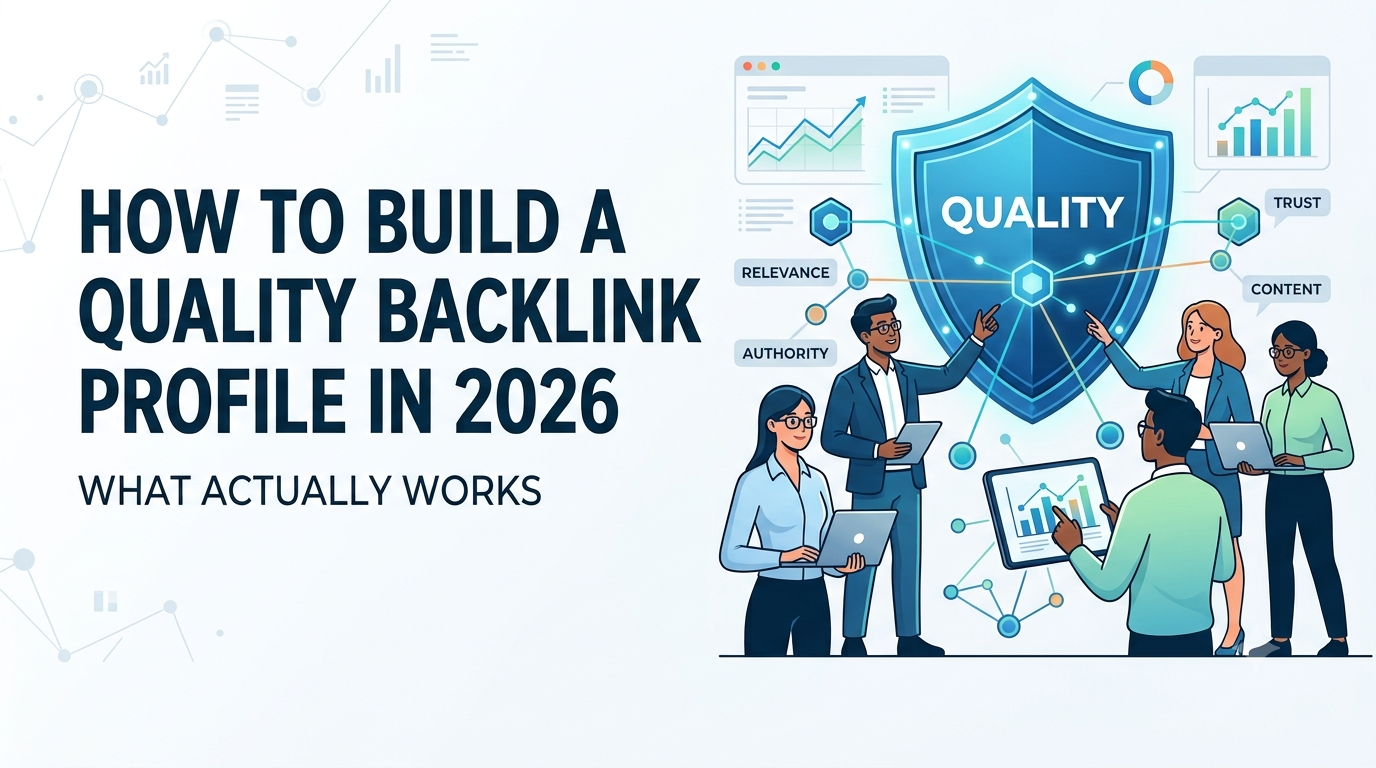
The Five Traits of a Link Worth Building
1. Topical relevance
A website covering digital marketing, e-commerce strategy, or business growth in Malaysia linking to your SEO services page carries real authority signal. A travel blog, a recipe site, or an unrelated directory linking to the same page carries almost none. Google understands what both the linking page and your page are about — relevance is now a primary signal, not a nice-to-have.
In practice, a relevant site with a DR of 35 will often outperform an irrelevant site with a DR of 80. Relevance over raw authority, every time.
2. Real organic traffic
A site with no organic visitors is a ghost town. Links from pages that nobody reads carry minimal trust signal because there is no evidence of genuine editorial value. Before pursuing a placement, check the site's organic traffic using any major SEO tool. If the traffic curve is flat at near-zero, move on.
3. Editorial placement
The most valuable links appear inside the body of an article — contextually, because the author found your content genuinely useful. Footer links, sidebar links, sponsored badge links, and sitewide links (appearing on every page of a site) carry progressively less weight. Google distinguishes between editorially earned links and mechanically placed ones.
4. Anchor text variety
A natural backlink profile uses a mix of anchor text types: branded anchors (your company name), generic anchors ("see here", "read this", "learn more"), naked URLs (your domain written out), and occasional partial-match or topic-relevant anchors. Exact-match commercial keyword anchors — the type that reads "SEO agency Malaysia" linking directly to your services page — should make up no more than 5–10% of your total profile. A profile dominated by commercial exact-match anchors is a textbook manipulation signal.
5. Source diversity
Twenty links from twenty different relevant domains is more powerful than twenty links from one site, even if that one site is highly authoritative. Diversity signals that multiple independent sources have found your content worth referencing — which is exactly the kind of organic authority pattern Google's algorithm is designed to reward.
Link Building Tactics That Produce Real Results
Digital PR
Getting your brand mentioned in reputable Malaysian media — The Star, The Edge, Malaysiakini, industry trade publications — earns editorial links from high-trust domains while simultaneously putting your brand in front of an audience that may already be looking for your services. Digital PR is time-intensive but produces the highest-value links available. A single feature in a credible publication can outperform dozens of directory listings.
What makes digital PR work: original data, a strong opinion backed by evidence, or a story angle that is genuinely newsworthy to a specific publication's audience. "Company launches new service" rarely qualifies. "Malaysian SMEs that invest in SEO recover search traffic 3x faster after Google algorithm updates" might.
Strategic guest posting
Guest posts on genuinely read, niche-relevant websites still work well — with an important qualifier. The publication needs to have real editorial standards and a real audience. A guest post on a respected industry blog with 30,000 monthly organic visitors is valuable. A guest post on a site that openly sells placements for a flat fee, with no editorial review, is a liability.
One or two contextual links back to relevant content on your site is appropriate in a guest post. Including five or six commercial keyword links in a single article is the kind of pattern that triggers Google's spam filters.
Broken link building
Find pages in your niche that contain dead outbound links — links to pages that no longer exist. Contact the page owner, point out the broken link, and offer your relevant content as a replacement. It is useful to the site owner, and the link you earn is editorial by nature. There are browser extensions and SEO tools that make finding broken links efficient.
Business partnerships and supplier citations
Existing business relationships are an underused link-building channel. Suppliers, partners, associations, and clients you work with regularly may all be willing to link to your site — either on a testimonials page, a partners directory, or in relevant content. These links are easy to earn, contextually relevant, and completely white-hat.
What to Avoid — and Why It Matters More Now
Private blog networks (PBNs) are clusters of sites built specifically to generate backlinks. They look increasingly artificial as Google's content quality detection has improved — thin content, low traffic, manipulative link patterns — and sites caught using them face manual penalties.
Paid link directories, article spinning networks, and bulk link packages from overseas SEO resellers all carry the same risk. Google's Link Spam systems have become sophisticated enough that these tactics now regularly produce net-negative outcomes: your rankings drop rather than improve, and recovery requires a disavow process that can take months.
For any business investing in serious SEO in Malaysia, the question is not "can we get away with it?" It is "do we want our rankings built on a foundation that could collapse overnight?" The answer should be clear.
How to Monitor Your Backlink Profile
Building links without monitoring them is like investing without checking your portfolio. Set up Google Search Console to receive notifications of manual actions. Use an SEO tool (Ahrefs, Semrush, or Moz) to track new and lost backlinks on a monthly basis. Watch for sudden spikes in low-quality referring domains — these can indicate negative SEO attacks, where a competitor points toxic links at your site.
If you identify a pattern of harmful links — particularly from PBNs or link farms — use Google's Disavow Tool to tell Google to ignore those links. It is a last resort, not a routine action, but knowing how to use it can protect a clean profile from external interference.
A strong backlink profile built through legitimate means is one of the most durable competitive advantages available in SEO. It compounds month over month, it cannot be copied overnight, and it signals genuine authority rather than technical manipulation. For businesses serious about long-term search visibility, it is worth the patience that earning real links requires.
Frequently Asked Questions
There is no fixed number. What matters is the quality and relevance of your backlinks relative to competitors in your specific niche. A local Malaysian business targeting regional keywords may need 20–50 high-quality referring domains to compete. Audit your top-ranking competitors to understand what a competitive link profile looks like for your specific target keywords.
Buying links with the intent to manipulate rankings violates Google's webmaster guidelines and can trigger a manual penalty that removes your site from search results. Google's Link Spam systems have become increasingly sophisticated at detecting paid links. Legitimate link-earning tactics carry zero risk and compound over time.
Most link-building campaigns produce measurable ranking improvements within 3–6 months. Individual links can begin influencing rankings 30–120 days after Google crawls and indexes them. Consistency matters more than volume — a steady stream of relevant earned links outperforms a one-time burst every time.
A natural anchor text profile is mostly branded, generic, and naked URL links, with a smaller proportion of partial-match and topic-relevant anchors. Exact-match commercial anchors should make up no more than 5–10% of your total profile. An over-optimised anchor text profile is one of the clearest signals of link manipulation to Google's spam systems.